




Follow us on Instagram
More Than an Outdoor Company.

@sawyerproducts
Follow us on Instagram


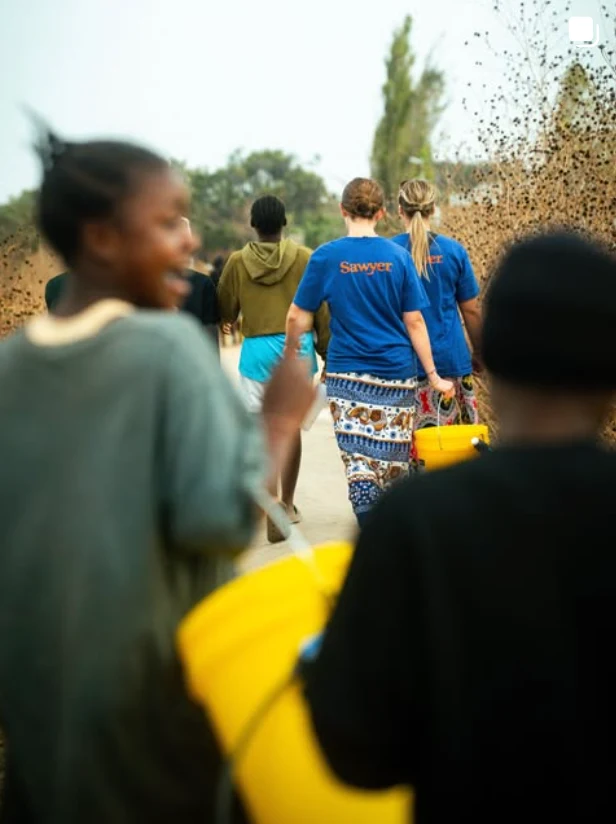

As we look to the future of clean water aid, we're asking ourselves questions in reflection. What lessons did we learn over the past 12 years?
Watch videoOn November 12th, 2020, at 3pm GMT, the last Liberian village received Sawyer filters, marking an end of a 12-year quest for border-to-border basic clean water access by The Last Well in partnership with Sawyer Products. While many people said this could never be accomplished, dedicated teams and some great, cost-effective clean water technology proved otherwise.
As we look to the future of clean water aid, we're asking ourselves questions in reflection. What lessons did we learn over the past 12 years? Is the border-to-border model replicable? What happens next?

If you want to give clean water to an entire country, you have to know where everyone lives. A Government Census can vary in accuracy depending on the country. For Liberia, there was not enough granular population and water source data for the rural bush villages. Sawyer brought Geographical Information Systems (GIS) to The Last Well’s border-to-border assessment process which marked a new achievement in Census accuracy.
The assessment teams traveled to every Liberian village, regardless of how easy it was to get there, hiking for hours to reach the previously unreached (more on that here). GIS technology allowed for accurate mapping of the country, and for surveys that included population, water source, and any existing water technology. The result was a much-improved water-point census that was shared with the Liberian government. In one county alone, 1300 villages were found that were not on the original Liberian census.
Once the country-wide assessment was complete, The Last Well deployed teams to methodically visit every village and provide clean water. The assessments allowed for a very cost-effective approach to the intervention, and Sawyer filters proved to be 4 times less costly than installing a hand pump well. Plus, using Sawyer filters created a lot of redundancies in the village that a well cannot replicate. If a $10 O-ring goes down on a hand pump well, the entire village loses its water. If someone loses their cleaning plunger from the Sawyer filter kit, there are numerous spare parts all throughout the village.

While it took 11 years to give clean water to 3.2 million people in Liberia, efficiencies brought about by the country-wide assessment, and Geographical Information System technology (GIS) could in hindsight, have cut the intervention time in half! Water filters allowed teams to go where well rigs could not go, and complete entire villages in one day.

How about 3 countries in the next 3 years?
The Last Well and Sawyer products are teaming up with the NGO Give Clean Water to bring clean water to some very challenging Pacific Islands: The Fiji Islands, The Solomon Islands, and The Marshall Islands. Using the same country-wide assessment strategy, these island nations will all achieve basic clean water access in the next 3 years.
Island countries represent a whole new batch of challenges with their remote locations and primitive infrastructure. Working in partnership with governments and NGOs, we’ll take the lessons learned in Liberia, and apply them to these Pacific Island chains and accelerate clean water access to all of the islands.
At Sawyer Products, we believe we’ll see clean water needs disappear in our lifetime. This is a solvable problem. In Liberia, they call Sawyer filters “Miracle Filters.” With one country completed, we believe in a world full of these same miracles.


On November 12th, 2020, at 3pm GMT, the last Liberian village received Sawyer filters, marking an end of a 12-year quest for border-to-border basic clean water access by The Last Well in partnership with Sawyer Products. While many people said this could never be accomplished, dedicated teams and some great, cost-effective clean water technology proved otherwise.
As we look to the future of clean water aid, we're asking ourselves questions in reflection. What lessons did we learn over the past 12 years? Is the border-to-border model replicable? What happens next?
If you want to give clean water to an entire country, you have to know where everyone lives. A Government Census can vary in accuracy depending on the country. For Liberia, there was not enough granular population and water source data for the rural bush villages. Sawyer brought Geographical Information Systems (GIS) to The Last Well’s border-to-border assessment process which marked a new achievement in Census accuracy.
The assessment teams traveled to every Liberian village, regardless of how easy it was to get there, hiking for hours to reach the previously unreached (more on that here). GIS technology allowed for accurate mapping of the country, and for surveys that included population, water source, and any existing water technology. The result was a much-improved water-point census that was shared with the Liberian government. In one county alone, 1300 villages were found that were not on the original Liberian census.
Once the country-wide assessment was complete, The Last Well deployed teams to methodically visit every village and provide clean water. The assessments allowed for a very cost-effective approach to the intervention, and Sawyer filters proved to be 4 times less costly than installing a hand pump well. Plus, using Sawyer filters created a lot of redundancies in the village that a well cannot replicate. If a $10 O-ring goes down on a hand pump well, the entire village loses its water. If someone loses their cleaning plunger from the Sawyer filter kit, there are numerous spare parts all throughout the village.
While it took 11 years to give clean water to 3.2 million people in Liberia, efficiencies brought about by the country-wide assessment, and Geographical Information System technology (GIS) could in hindsight, have cut the intervention time in half! Water filters allowed teams to go where well rigs could not go, and complete entire villages in one day.
How about 3 countries in the next 3 years?
The Last Well and Sawyer products are teaming up with the NGO Give Clean Water to bring clean water to some very challenging Pacific Islands: The Fiji Islands, The Solomon Islands, and The Marshall Islands. Using the same country-wide assessment strategy, these island nations will all achieve basic clean water access in the next 3 years.
Island countries represent a whole new batch of challenges with their remote locations and primitive infrastructure. Working in partnership with governments and NGOs, we’ll take the lessons learned in Liberia, and apply them to these Pacific Island chains and accelerate clean water access to all of the islands.
At Sawyer Products, we believe we’ll see clean water needs disappear in our lifetime. This is a solvable problem. In Liberia, they call Sawyer filters “Miracle Filters.” With one country completed, we believe in a world full of these same miracles.
On November 12th, 2020, at 3pm GMT, the last Liberian village received Sawyer filters, marking an end of a 12-year quest for border-to-border basic clean water access by The Last Well in partnership with Sawyer Products. While many people said this could never be accomplished, dedicated teams and some great, cost-effective clean water technology proved otherwise.
As we look to the future of clean water aid, we're asking ourselves questions in reflection. What lessons did we learn over the past 12 years? Is the border-to-border model replicable? What happens next?
If you want to give clean water to an entire country, you have to know where everyone lives. A Government Census can vary in accuracy depending on the country. For Liberia, there was not enough granular population and water source data for the rural bush villages. Sawyer brought Geographical Information Systems (GIS) to The Last Well’s border-to-border assessment process which marked a new achievement in Census accuracy.
The assessment teams traveled to every Liberian village, regardless of how easy it was to get there, hiking for hours to reach the previously unreached (more on that here). GIS technology allowed for accurate mapping of the country, and for surveys that included population, water source, and any existing water technology. The result was a much-improved water-point census that was shared with the Liberian government. In one county alone, 1300 villages were found that were not on the original Liberian census.
Once the country-wide assessment was complete, The Last Well deployed teams to methodically visit every village and provide clean water. The assessments allowed for a very cost-effective approach to the intervention, and Sawyer filters proved to be 4 times less costly than installing a hand pump well. Plus, using Sawyer filters created a lot of redundancies in the village that a well cannot replicate. If a $10 O-ring goes down on a hand pump well, the entire village loses its water. If someone loses their cleaning plunger from the Sawyer filter kit, there are numerous spare parts all throughout the village.
While it took 11 years to give clean water to 3.2 million people in Liberia, efficiencies brought about by the country-wide assessment, and Geographical Information System technology (GIS) could in hindsight, have cut the intervention time in half! Water filters allowed teams to go where well rigs could not go, and complete entire villages in one day.
How about 3 countries in the next 3 years?
The Last Well and Sawyer products are teaming up with the NGO Give Clean Water to bring clean water to some very challenging Pacific Islands: The Fiji Islands, The Solomon Islands, and The Marshall Islands. Using the same country-wide assessment strategy, these island nations will all achieve basic clean water access in the next 3 years.
Island countries represent a whole new batch of challenges with their remote locations and primitive infrastructure. Working in partnership with governments and NGOs, we’ll take the lessons learned in Liberia, and apply them to these Pacific Island chains and accelerate clean water access to all of the islands.
At Sawyer Products, we believe we’ll see clean water needs disappear in our lifetime. This is a solvable problem. In Liberia, they call Sawyer filters “Miracle Filters.” With one country completed, we believe in a world full of these same miracles.
More Than an Outdoor Company.

