















Follow us on Instagram
More Than an Outdoor Company.

@sawyerproducts
Follow us on Instagram










Sometimes understanding how water behaves is just as important as knowing where to find it.
Watch videoI have been working for many years delivering survival courses in the Amazon, guiding people from all over the world through environments where we spend many days moving through remote areas, far from any infrastructure.
In this context, water stops being just a comfort — it becomes a direct safety factor.
That is why, in the field, I have always used reliable Sawyer Products filters as part of my operational routine.
%20copy.webp)
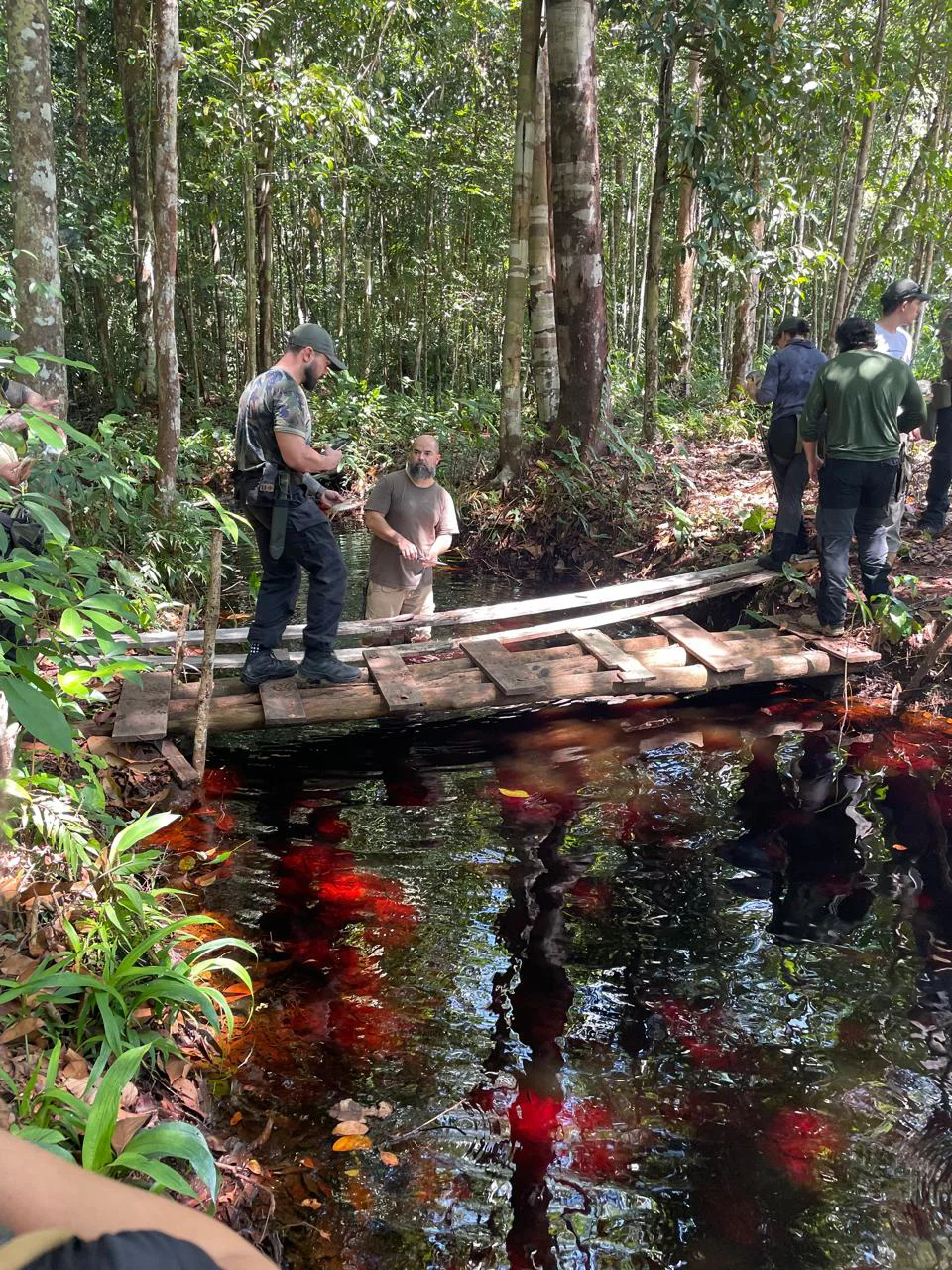
During one of these expeditions, I used the Sawyer Mini to treat water collected from a typical local stream. The water was suitable for collection, but it had a common characteristic in the forest: a dark color, caused by tannins (a term I did not yet know at the time).
The filter performed perfectly for its intended purpose—removing microorganisms — but something caught my attention: even after filtration, the water still had color.
Yes, exactly.

This “surprise” turned out to be an excellent technical learning experience.
Because our base in the Amazon is supplied by tributaries, small streams, and creeks that originate from the Rio Negro, the water naturally has this dark coloration.
The Rio Negro has high levels of humic acid, which gives the water a dark appearance. This happens mainly because the river carries very little suspended sediment. In most rivers, suspended particles provide humic acids with a surface to stick to, a process called adsorption, which removes them from the water. But since the Rio Negro has so little sediment, there are not many surfaces for the acids to attach to except the riverbed. As a result, the acids stay dissolved in the water, so their levels remain high.
At that moment, I immediately returned to base, because I was using a brand-new filter and wanted to make sure there was no malfunction. In turbid waters, the filtered water usually comes out crystal clear, but in this dark stream, the water still showed coloration.
To better understand what was happening, I tested two additional filters provided by other members of our team. Each one worked the same way. So, I decided to reach out to Sawyer, and that's when we received a clear explanation—and it's something worth sharing with anyone traveling to areas where the water contains tannins.
If you notice this effect, there's no need to worry.
%20copy.webp)
Tannins are natural organic compounds released mainly by the decomposition of leaves, branches, and plant material on the forest floor. They dissolve in the water and are responsible for the brownish or “tea-like” color that is very common in Amazonian streams and flooded areas. They are not suspended dirt, but dissolved substances.
From a technical standpoint, membrane filters — such as the Sawyer Mini — are designed to remove protozoa, bacteria, and microplastics through physical filtration. However, tannins are not solid particles; they are dissolved molecules in the water. For this reason, they are not removed by this type of filtration.
The result is exactly what I observed in the field: water treated for bacteria and protozoa and cysts, but still with color.
This detail is extremely important for anyone working in jungle environments, long expeditions, and remote operations. The presence of tannins alone does not indicate that the water is biologically contaminated. It simply reflects the high natural organic load of that ecosystem.
%20copy.webp)
Membrane filters are essential for protection against pathogens.
Water coloration in forest environments is often related to natural processes — not to equipment failure.
%20copy.webp)
Fortunately, there are no health problems associated with tannins in water. Most issues related to tannins are limited to making the water less pleasant to drink and to the possibility of staining plumbing surfaces and clothing. However, the filter will certainly remove what truly matters — bacteria and protozoa — allowing you to have safe drinking water.
In the Amazon, in the tropics, and anywhere tannins may be present, understanding how water behaves is just as important as knowing where to find it.
Learning to interpret what nature itself shows us — as in the case of tannins — is an essential part of technical and conscious survival in extreme environments.


I have been working for many years delivering survival courses in the Amazon, guiding people from all over the world through environments where we spend many days moving through remote areas, far from any infrastructure.
In this context, water stops being just a comfort — it becomes a direct safety factor.
That is why, in the field, I have always used reliable Sawyer Products filters as part of my operational routine.
During one of these expeditions, I used the Sawyer Mini to treat water collected from a typical local stream. The water was suitable for collection, but it had a common characteristic in the forest: a dark color, caused by tannins (a term I did not yet know at the time).
The filter performed perfectly for its intended purpose—removing microorganisms — but something caught my attention: even after filtration, the water still had color.
Yes, exactly.
This “surprise” turned out to be an excellent technical learning experience.
Because our base in the Amazon is supplied by tributaries, small streams, and creeks that originate from the Rio Negro, the water naturally has this dark coloration.
The Rio Negro has high levels of humic acid, which gives the water a dark appearance. This happens mainly because the river carries very little suspended sediment. In most rivers, suspended particles provide humic acids with a surface to stick to, a process called adsorption, which removes them from the water. But since the Rio Negro has so little sediment, there are not many surfaces for the acids to attach to except the riverbed. As a result, the acids stay dissolved in the water, so their levels remain high.
At that moment, I immediately returned to base, because I was using a brand-new filter and wanted to make sure there was no malfunction. In turbid waters, the filtered water usually comes out crystal clear, but in this dark stream, the water still showed coloration.
To better understand what was happening, I tested two additional filters provided by other members of our team. Each one worked the same way. So, I decided to reach out to Sawyer, and that's when we received a clear explanation—and it's something worth sharing with anyone traveling to areas where the water contains tannins.
If you notice this effect, there's no need to worry.
Tannins are natural organic compounds released mainly by the decomposition of leaves, branches, and plant material on the forest floor. They dissolve in the water and are responsible for the brownish or “tea-like” color that is very common in Amazonian streams and flooded areas. They are not suspended dirt, but dissolved substances.
From a technical standpoint, membrane filters — such as the Sawyer Mini — are designed to remove protozoa, bacteria, and microplastics through physical filtration. However, tannins are not solid particles; they are dissolved molecules in the water. For this reason, they are not removed by this type of filtration.
The result is exactly what I observed in the field: water treated for bacteria and protozoa and cysts, but still with color.
This detail is extremely important for anyone working in jungle environments, long expeditions, and remote operations. The presence of tannins alone does not indicate that the water is biologically contaminated. It simply reflects the high natural organic load of that ecosystem.
Membrane filters are essential for protection against pathogens.
Water coloration in forest environments is often related to natural processes — not to equipment failure.
Fortunately, there are no health problems associated with tannins in water. Most issues related to tannins are limited to making the water less pleasant to drink and to the possibility of staining plumbing surfaces and clothing. However, the filter will certainly remove what truly matters — bacteria and protozoa — allowing you to have safe drinking water.
In the Amazon, in the tropics, and anywhere tannins may be present, understanding how water behaves is just as important as knowing where to find it.
Learning to interpret what nature itself shows us — as in the case of tannins — is an essential part of technical and conscious survival in extreme environments.
I have been working for many years delivering survival courses in the Amazon, guiding people from all over the world through environments where we spend many days moving through remote areas, far from any infrastructure.
In this context, water stops being just a comfort — it becomes a direct safety factor.
That is why, in the field, I have always used reliable Sawyer Products filters as part of my operational routine.
During one of these expeditions, I used the Sawyer Mini to treat water collected from a typical local stream. The water was suitable for collection, but it had a common characteristic in the forest: a dark color, caused by tannins (a term I did not yet know at the time).
The filter performed perfectly for its intended purpose—removing microorganisms — but something caught my attention: even after filtration, the water still had color.
Yes, exactly.
This “surprise” turned out to be an excellent technical learning experience.
Because our base in the Amazon is supplied by tributaries, small streams, and creeks that originate from the Rio Negro, the water naturally has this dark coloration.
The Rio Negro has high levels of humic acid, which gives the water a dark appearance. This happens mainly because the river carries very little suspended sediment. In most rivers, suspended particles provide humic acids with a surface to stick to, a process called adsorption, which removes them from the water. But since the Rio Negro has so little sediment, there are not many surfaces for the acids to attach to except the riverbed. As a result, the acids stay dissolved in the water, so their levels remain high.
At that moment, I immediately returned to base, because I was using a brand-new filter and wanted to make sure there was no malfunction. In turbid waters, the filtered water usually comes out crystal clear, but in this dark stream, the water still showed coloration.
To better understand what was happening, I tested two additional filters provided by other members of our team. Each one worked the same way. So, I decided to reach out to Sawyer, and that's when we received a clear explanation—and it's something worth sharing with anyone traveling to areas where the water contains tannins.
If you notice this effect, there's no need to worry.
Tannins are natural organic compounds released mainly by the decomposition of leaves, branches, and plant material on the forest floor. They dissolve in the water and are responsible for the brownish or “tea-like” color that is very common in Amazonian streams and flooded areas. They are not suspended dirt, but dissolved substances.
From a technical standpoint, membrane filters — such as the Sawyer Mini — are designed to remove protozoa, bacteria, and microplastics through physical filtration. However, tannins are not solid particles; they are dissolved molecules in the water. For this reason, they are not removed by this type of filtration.
The result is exactly what I observed in the field: water treated for bacteria and protozoa and cysts, but still with color.
This detail is extremely important for anyone working in jungle environments, long expeditions, and remote operations. The presence of tannins alone does not indicate that the water is biologically contaminated. It simply reflects the high natural organic load of that ecosystem.
Membrane filters are essential for protection against pathogens.
Water coloration in forest environments is often related to natural processes — not to equipment failure.
Fortunately, there are no health problems associated with tannins in water. Most issues related to tannins are limited to making the water less pleasant to drink and to the possibility of staining plumbing surfaces and clothing. However, the filter will certainly remove what truly matters — bacteria and protozoa — allowing you to have safe drinking water.
In the Amazon, in the tropics, and anywhere tannins may be present, understanding how water behaves is just as important as knowing where to find it.
Learning to interpret what nature itself shows us — as in the case of tannins — is an essential part of technical and conscious survival in extreme environments.
More Than an Outdoor Company.

