











Follow us on Instagram
More Than an Outdoor Company.

@sawyerproducts
Follow us on Instagram



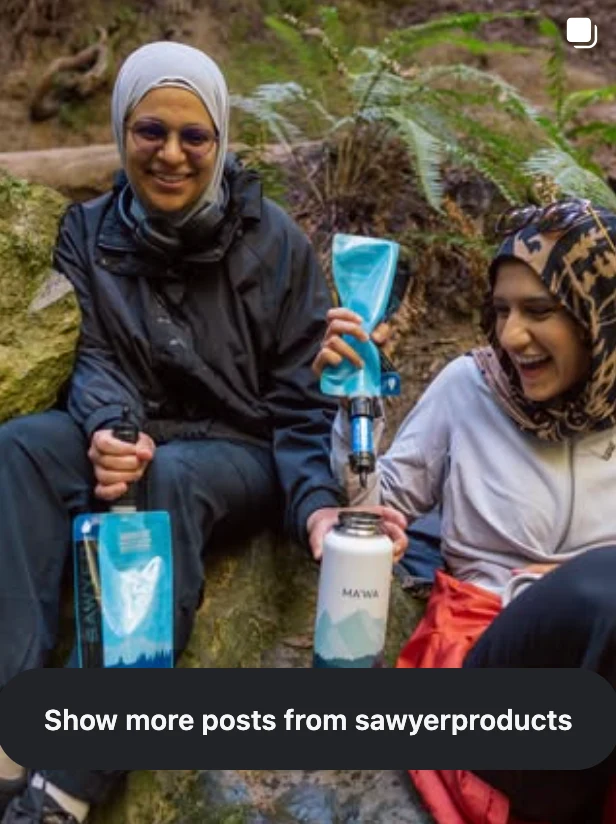

Follow these tips to avoid common dangers while backpacking and hiking.
Watch videoFollow these tips to avoid common dangers while backpacking and hiking.
One of Thomas Coyne’s scariest incidents happened while on a day hike with friends in the foothills of the Sierra Nevada. After climbing up to the top of a flat boulder with cracks in a number of places, “I heard what sounded like 100 rattlesnakes,” says Coyne, who’d accidentally climbed onto a rattlesnake nest.
“I had to stay as calm as I could. I took high steps and ninja walked over the rest of the cracks as I slowly backed off the rock.” Luckily, he didn’t get bitten. “But I was so freaked out that when I got to the trail, I sprinted for 100 yards.”
As a professional survival instructor, Coyne, the founder and chief instructor of Coyne Survival Schools in California, has trained many military operators on wilderness survival – from U.S. Navy Search and Rescue personnel to U.S. Marine Corps Mountain Warfare Training Center Marines – so he knew how to respond in a way that de-escalated the danger.
My experience with rattlesnakes, thankfully, has been more limited. I’ve hiked Caprock Canyons State Park in west Texas, where rattlesnakes are plentiful among the colorful canyons and steep bluffs. On one occasion, my aunt and I had to back away and take another path when a rattlesnake was spotted on the trail.
Like Coyne, I’ve learned that a day hike can pose more risks than an extended journey simply because it’s easier to head out unprepared when you assume you’ll be back to civilization in a few hours.
Continue reading ways ti stay prepared in the wild, written by Dawn Reiss here.


Follow these tips to avoid common dangers while backpacking and hiking.
One of Thomas Coyne’s scariest incidents happened while on a day hike with friends in the foothills of the Sierra Nevada. After climbing up to the top of a flat boulder with cracks in a number of places, “I heard what sounded like 100 rattlesnakes,” says Coyne, who’d accidentally climbed onto a rattlesnake nest.
“I had to stay as calm as I could. I took high steps and ninja walked over the rest of the cracks as I slowly backed off the rock.” Luckily, he didn’t get bitten. “But I was so freaked out that when I got to the trail, I sprinted for 100 yards.”
As a professional survival instructor, Coyne, the founder and chief instructor of Coyne Survival Schools in California, has trained many military operators on wilderness survival – from U.S. Navy Search and Rescue personnel to U.S. Marine Corps Mountain Warfare Training Center Marines – so he knew how to respond in a way that de-escalated the danger.
My experience with rattlesnakes, thankfully, has been more limited. I’ve hiked Caprock Canyons State Park in west Texas, where rattlesnakes are plentiful among the colorful canyons and steep bluffs. On one occasion, my aunt and I had to back away and take another path when a rattlesnake was spotted on the trail.
Like Coyne, I’ve learned that a day hike can pose more risks than an extended journey simply because it’s easier to head out unprepared when you assume you’ll be back to civilization in a few hours.
Continue reading ways ti stay prepared in the wild, written by Dawn Reiss here.
Follow these tips to avoid common dangers while backpacking and hiking.
One of Thomas Coyne’s scariest incidents happened while on a day hike with friends in the foothills of the Sierra Nevada. After climbing up to the top of a flat boulder with cracks in a number of places, “I heard what sounded like 100 rattlesnakes,” says Coyne, who’d accidentally climbed onto a rattlesnake nest.
“I had to stay as calm as I could. I took high steps and ninja walked over the rest of the cracks as I slowly backed off the rock.” Luckily, he didn’t get bitten. “But I was so freaked out that when I got to the trail, I sprinted for 100 yards.”
As a professional survival instructor, Coyne, the founder and chief instructor of Coyne Survival Schools in California, has trained many military operators on wilderness survival – from U.S. Navy Search and Rescue personnel to U.S. Marine Corps Mountain Warfare Training Center Marines – so he knew how to respond in a way that de-escalated the danger.
My experience with rattlesnakes, thankfully, has been more limited. I’ve hiked Caprock Canyons State Park in west Texas, where rattlesnakes are plentiful among the colorful canyons and steep bluffs. On one occasion, my aunt and I had to back away and take another path when a rattlesnake was spotted on the trail.
Like Coyne, I’ve learned that a day hike can pose more risks than an extended journey simply because it’s easier to head out unprepared when you assume you’ll be back to civilization in a few hours.
Continue reading ways ti stay prepared in the wild, written by Dawn Reiss here.
More Than an Outdoor Company.

